
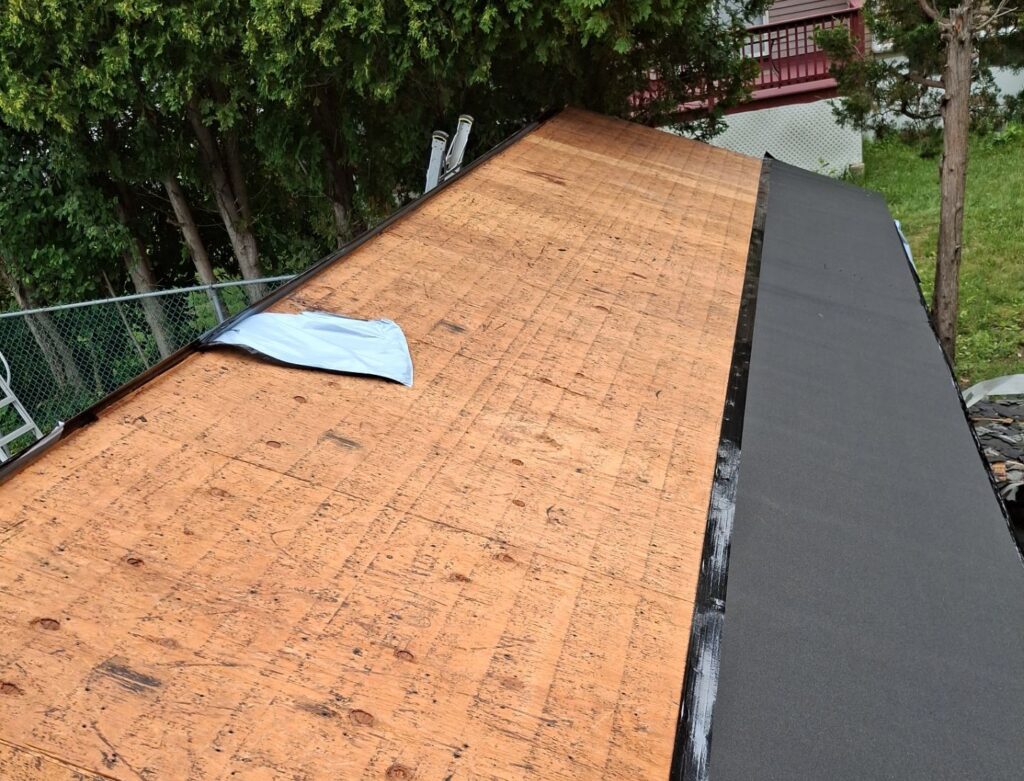
The roof sheathing, or decking, is the foundational layer beneath the underlayment and shingles. It provides the crucial structural support for the entire roofing system, anchors the fasteners, and withstands snow loads and high winds. Using the wrong material, or the wrong thickness, can lead to premature roofing material failure and eventual roof deck sagging.
Masterpiece Roofing always ensures that all replacement sheathing meets or exceeds current local building codes, guaranteeing the structural integrity of your entire roofing system.
Roof Sheathing Materials: Plywood vs. OSB vs. Residential Boards
The choice of sheathing material is primarily between two engineered wood products, selected based on performance and cost.
Typical Plywood Grades (CDX, Sheathing Panels)
- Plywood: Constructed from thin sheets (veneers) of wood glued together with alternating grain directions. The alternating layers provide superior resistance to swelling and warping when exposed to moisture. Plywood is typically graded as CDX, meaning C-grade face veneer, D-grade back veneer, and exposure classification (X) for exterior use.
- OSB (Oriented Strand Board): Made from wood strands or flakes arranged in specific orientations and bonded with resins. OSB is often more economical and widely used in new residential construction.
Thickness and Span Ratings
Sheathing thickness is determined by the spacing of the roof trusses or rafters (the span).
- 16-inch Span: Requires a minimum of $7/16$ inch thickness.
- 24-inch Span: Requires a minimum of $5/8$ inch thickness.
The material must be installed with the proper “span rating” visible, ensuring the panel is oriented correctly for the framing beneath it.
How Moisture, Wind, and Load Affect Choice
- Moisture Resistance: Plywood generally handles repeated exposure to water better than OSB, which can swell significantly, particularly at the edges, leading to “wavy” shingles. If the roof is exposed to rain during installation, plywood is a safer choice.
- Wind and Load (Snow): Both materials perform equally when installed at the correct thickness and securely fastened. The key is meeting the local load requirements specified by the building code for snow accumulation.
Why Proper Sheathing Matters for Roof Performance
The sheathing’s role extends beyond simply holding the shingles.
Supports Roofing Material and Prevents Sagging
Properly thick and structurally sound sheathing prevents deflection (sagging) between the rafters. If the sheathing sags, it creates low spots where water can pool, and the roofing material itself (shingles, felt, or metal) can crack or fail prematurely due to stress.
Impacts Insulation and Ventilation Systems
The sheathing forms the upper boundary of the attic space. It must be installed correctly to allow for adequate spacing for intake and exhaust vents (e.g., soffit and ridge vents) that manage heat and moisture. Adequate ventilation prevents ice dams in winter and extends the life of the shingles by keeping the roof deck cool in summer.
Local Building Code Considerations
While specific codes vary, requirements are driven by the need to support heavy winter loads and high winds.
Minimum Thickness for Snow Loads
In regions that experience significant snowfall, the minimum thickness of $7/16$ inch for 16-inch spans may be sufficient, but local codes may require upgrading to $5/8$ inch sheathing, particularly in areas with higher structural risk or longer spans. Always confirm the required thickness based on the structural engineer’s or architect’s original specifications.
Fastening Schedules and Spacing
Building codes mandate specific fastening patterns to ensure the sheathing can resist wind uplift and securely hold the roofing material. Panels are typically fastened with $8d$ common nails or screws spaced:
- Every 6 inches along the edges (where panels meet).
- Every 12 inches in the field (the middle of the panel).
Failure to follow this schedule is a common cause of roof failure in high winds.
FAQs
“Can I reinstall plywood over old decking?”
No. Building codes require the structural integrity of the roof deck to be inspected and confirmed. When replacing an old roof, the existing decking must be fully exposed (all old material removed). If the underlying decking is found to be rotten, moldy, or deteriorated, it must be replaced. Attempting to install new plywood over old, damaged wood violates code and creates a non-structural base.
“Is OSB okay instead of plywood?”
Yes, if it is the correct grade and thickness. OSB is an accepted material under most US building codes and is generally more budget-friendly than plywood. The critical difference lies in moisture handling: if your attic ventilation is poor, OSB may swell more noticeably than plywood. Both materials must have the correct span rating for your rafter spacing.
“What thickness does the inspector require?”
The thickness requirement is set by the local building department based on the distance between your rafters/trusses (the span) and the required snow load rating for your area. For standard residential construction with 16-inch spans, $7/16$ inch is typically the minimum, but many contractors prefer $1/2$ inch or $5/8$ inch for added stability, especially in high-load areas. Always confirm with the local inspector or your licensed contractor.
Ensure your roof is supported by a deck that meets the highest safety standards.
Contact Masterpiece Roofing today for a detailed roof deck inspection and structural assessment.