
For any property owner, the term “flat roof” is a bit of a misnomer. In the roofing industry, these are technically “low-slope” systems. Because water does not shed as naturally as it does on a gabled or hipped roof, the drainage system is the most critical component of the entire assembly. At Masterpiece Roofing, we understand that a flat roof is only as good as its ability to move water off the surface and away from the foundation.
Quick Answer: Flat Roofs Need a Drainage Plan—Small Slope + Clear Drain Points
A successful flat roof requires a dual-strategy: a subtle integrated slope (typically at least 1/4 inch per foot) to prevent “ponding,” and a high-capacity exit strategy through internal drains, scuppers, or gutters. Without a dedicated drainage plan, water will eventually find its way into the building envelope through hydrostatic pressure or material degradation.
Why “flat” roofs still require pitch and drainage design
Gravity is the only reliable way to move water. Even a roof that appears perfectly level must have a “pitch.” In the United States, building codes generally require a minimum slope of 2% (1/4:12) for new construction. Proper pitch ensures that water migrates toward the drainage points rather than sitting in the center of the roof. Without this design, the weight of standing water can cause “deflection,” where the roof deck bows under the weight, creating a deeper pool and leading to potential structural failure.
Types of Flat Roof Drainage Systems
The architecture of your building and the local climate will dictate which drainage system is most effective.
Internal roof drains (and why strainers matter)
Internal drains are located at the low points of the roof, often near the center. They connect to a network of pipes that run through the building’s interior and exit into the storm sewer or a designated runoff area.
- The Benefit: They are protected from freezing by the building’s internal heat and provide a clean aesthetic as no pipes are visible on the exterior walls.
- The Role of Strainers: Dome-style strainers (often called “beehives”) are essential. They allow water to flow into the drain even if some debris accumulates at the base. Without a strainer, a single plastic bag or a handful of leaves can turn your roof into a swimming pool.
Scuppers (where they work best)
Scuppers are openings cut into the parapet wall at the roof’s edge. Water flows through these openings and into a conductor head or downspout on the exterior of the building.
- Ideal Use: Scuppers are highly effective for roofs with a perimeter wall (parapet). They are easier to maintain than internal drains because the entire system is visible and accessible.
- Overflow Scuppers: Most professional designs include “overflow” scuppers placed 2 inches above the primary drainage point. If the main drain clogs, the overflow scupper acts as a safety valve, preventing water from reaching dangerous depths.
Perimeter gutters
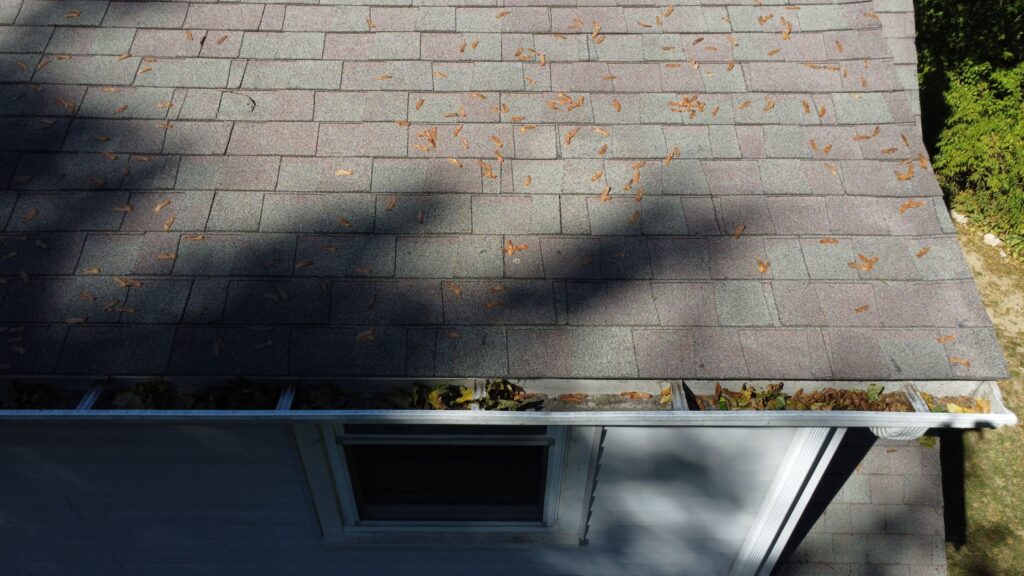
Common on residential flat roofs and smaller commercial structures, gutters are attached to the eave of the roof.
- The Advantage: This is often the least expensive option and provides an easy way to divert water away from the building’s foundation using extensions or splash blocks.
Tapered insulation and crickets for better flow
If a roof deck is structurally level, we create “artificial” slope using tapered insulation. This involves installing rigid foam boards of varying thicknesses to create a high point and a low point.
- Crickets: These are diamond or V-shaped ridges made of insulation, placed between drains or behind chimneys. They act like “speed bumps” for water, redirecting it toward the drains and preventing stagnant pockets behind roof penetrations.
Most Common Drainage Issues on Flat Roofs
Ponding water (what “too long” means)
“Ponding” is defined by the NRCA (National Roofing Contractors Association) as water that remains on a roof for 48 hours or longer after a rainfall.
- The Danger: Ponding water acts as a magnifying glass for UV rays, accelerating the degradation of the roof membrane. Additionally, it encourages the growth of algae and vegetation, which can root into the roofing material.
Clogged drains/scuppers (leaves, debris, ice)
A drainage system is only functional if it is clear. In the fall, leaves are the primary culprit. In the winter, “ice damming” can occur in scuppers if the exterior pipes freeze, preventing meltwater from escaping.
Improper slope or drain placement
If a building has settled over time, the “low point” may have shifted away from the original drain. This requires a professional assessment to determine if new drains need to be cut or if the slope needs to be corrected with a new insulation layout.
How to Fix Flat Roof Drainage Problems
Cleaning + installing strainers/screens
The simplest fix is a rigorous maintenance schedule. Removing organic debris twice a year and ensuring that high-quality, metal beehive strainers are securely in place can prevent 90% of emergency leaks.
Correcting slope (tapered insulation)
During a roof replacement (re-roof), we can install a custom-engineered tapered polyiso insulation system. This is the gold standard for fixing drainage issues, as it addresses the root cause: the lack of gravity-assisted flow.
Adding/relocating drains or scuppers
If ponding is severe, we can perform a “surgical” fix by adding an additional scupper or drain at the new low point of the roof. This ensures that even as a building settles, the water always has an exit path.
FAQs
Why does my flat roof hold water after rain?
Small puddles that evaporate within 24 to 48 hours are generally considered normal. However, if the water remains for days, it indicates either a lack of proper slope, a structural sag in the roof deck, or a partial blockage in your drainage pipes.
Are scuppers better than internal drains?
It depends on the building. Scuppers are generally easier to maintain and less likely to leak into the interior of the building if they fail. Internal drains are better for very large roof surfaces where water would have to travel too far to reach a perimeter wall.
How often should flat roof drains be inspected?
At a minimum, twice a year—once in the spring and once in the fall. You should also check your drainage points after any major storm or high-wind event to ensure no large debris has blocked the flow.
Contact Masterpiece Roofing today for a professional drainage audit and ensure your flat roof stays dry and durable for years to come.