
One of the most persistent questions homeowners ask when switching to a metal roof is whether they are inadvertently turning their home into a giant lightning magnet. In Massachusetts, where seasonal storms can be intense, understanding the relationship between metal roofing and atmospheric electricity is vital for both safety and peace of mind.
Quick Answer: Metal Roofs Don’t Attract Lightning—But Protection May Still Be Worth It
The most important fact to establish is that metal roofing does not increase the mathematical probability of your home being struck by lightning. Lightning is looking for the path of least resistance to the ground, and it is influenced by factors far more significant than the material on your rafters.
What Determines Lightning Strikes?
Lightning is attracted to the highest point in a given area, regardless of material. The primary factors include:
- Height: The tallest structure in the immediate vicinity is most likely to be the strike point.
- Location: Isolated structures or those located on top of hills are at higher risk.
- Topography: Proximity to bodies of water or open plains can influence strike patterns.
Why Metal Can Reduce Fire Risk
While metal doesn’t attract lightning, it is a non-combustible and conductive material. If a lightning strike does occur, a metal roof helps to spread the electrical charge over a larger surface area. Unlike wood shingles or asphalt, which can ignite instantly upon a strike, metal provides a safer “skin” for the building, provided the energy has a clear path to the earth.
Do You Need a Lightning Rod with a Metal Roof?
Whether or not you should invest in a dedicated Lightning Protection System (LPS) depends on your specific property profile.
Higher-Risk Scenarios
You should strongly consider a lightning protection system if your Massachusetts home falls into these categories:
- Homes on Hills: Properties at higher elevations compared to surrounding terrain.
- Coastal Exposure: Homes near the ocean often face more direct exposure to severe weather systems.
- Tall Trees: If your home is surrounded by tall trees that are close to the structure, a strike to a tree can “jump” to the house (side-flash).
- Isolated Properties: If your home is the only significant structure in a large open area.
When “No” is a Reasonable Answer
For a typical residential home in a suburban neighborhood, where there are many structures of similar height and plenty of surrounding utility poles or taller buildings, the statistical risk is extremely low. In these cases, a standard metal roof installed to building code is often considered sufficient.
What a Lightning Protection System Includes
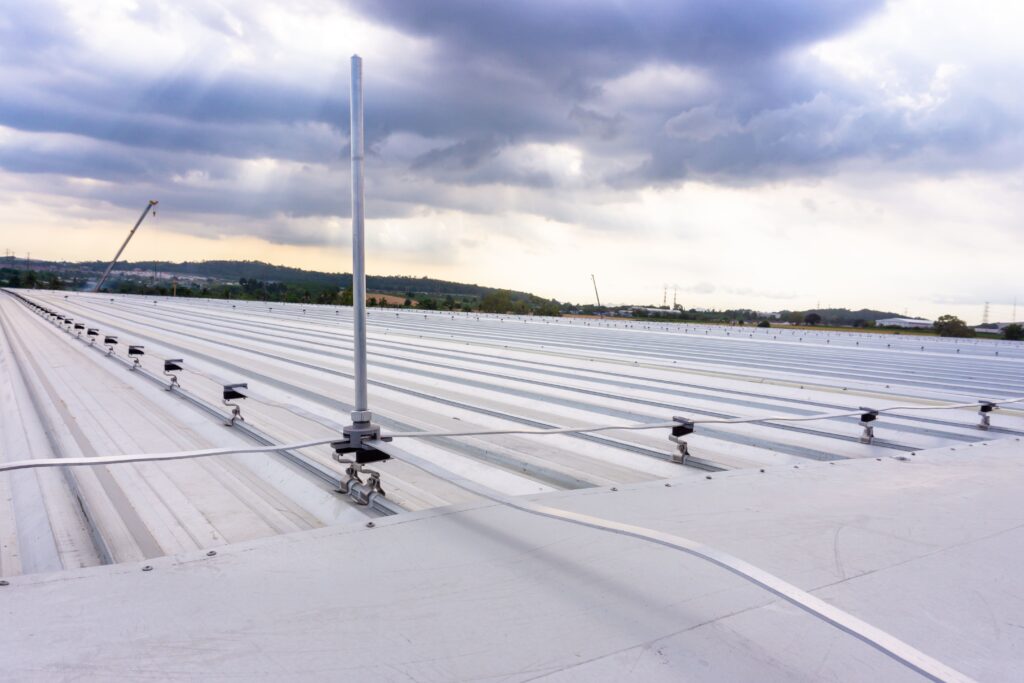
A professional Lightning Protection System (LPS) is not just a “rod” on the roof; it is a complex network designed to intercept electricity and usher it safely into the ground.
1. Air Terminals (Strike Points)
These are the small, vertical rods (often called lightning rods) placed at intervals along the ridges and high points of the roof. They are designed to be the “preferred” strike point.
2. Down Conductors + Grounding
Heavy-duty copper or aluminum cables connect the air terminals to grounding rods buried deep in the earth. This ensures the electricity bypasses the home’s interior structure.
3. Bonding
This involves connecting the LPS to the metal components of the house (like gutters or vents) to prevent “side flashes,” where electricity jumps between metal objects inside the walls.
4. Surge Protection
An LPS protects the structure from fire, but it does not necessarily protect sensitive electronics. A whole-house surge protector is a critical secondary layer to save appliances and computers from the electromagnetic pulse of a strike.
NFPA 780 Basics Homeowners Should Know
The National Fire Protection Association (NFPA) 780 is the standard for the installation of lightning protection systems in the United States. It provides the guidelines for “Grounded Systems.” Even if a metal roof is conductive, it is not considered “self-grounding.” To meet safety standards, a metal roof must be integrated into a system that follows NFPA 780 protocols to ensure the energy is channeled effectively without heat buildup that could cause structural damage.
Common Myths (and the Real Risks)
Myth: “Metal makes strikes more likely”
The Reality: Testing by the Lightning Protection Institute has proven that metal roofs do not attract lightning any more than any other roofing material.
The Real Risk: Lack of Grounding
The danger isn’t the metal; it’s the energy having nowhere to go. Without a proper pathway to the ground, lightning can travel through gas pipes, electrical wiring, or telephone lines, leading to catastrophic fires or explosive damage to the home’s infrastructure.
FAQs
Is a grounded metal roof safer than shingles during a strike?
Yes. Because metal is a conductor and non-combustible, a properly grounded metal roof is arguably the safest place to be during a strike, as it facilitates the movement of electricity without catching fire.
Will a lightning system protect everything in my home?
The external system protects the structure from fire and physical damage. Internal protection (surge suppressors) is required to protect your electronics.
Do I need surge protectors too?
Absolutely. A lightning strike creates a massive power surge that can travel through utility lines. We recommend a “two-stage” approach: an LPS for the roof and a surge protector for the electrical panel.
Schedule a Roof Inspection in Massachusetts
Protecting your home starts with a professional assessment. Whether you are looking to install a new metal roof or want to evaluate the safety of your current structure, Masterpiece Roofing is here to help. Our experts understand the unique weather challenges of the Northeast and can ensure your roof is beautiful, durable, and safe.
Don’t leave your safety to chance. Contact Masterpiece Roofing today for a comprehensive roof inspection and consultation!