
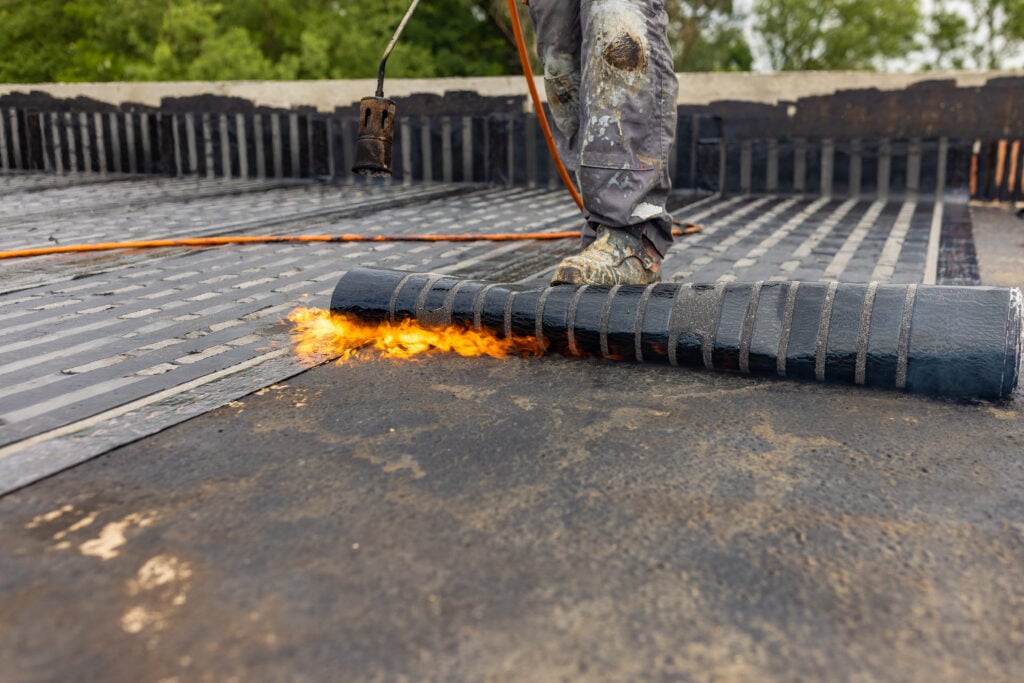
Maintaining a flat commercial roof is crucial for preventing water damage and preserving the overall structure of a building. Flat roofs—which typically have a slope of 1/4 inch per foot—rely on continuous, sealed membranes and efficient drainage to function correctly. When problems arise, the repair method must be specifically tailored to the type of membrane (TPO, EPDM, PVC, modified bitumen, etc.) and the root cause of the damage.
Quick Answer: Flat Roof Repairs Depend on the Problem
Flat roof repair is not a one-size-fits-all job. The type of solution applied is dictated by the specific failure mode, the extent of the damage, and the overall condition of the roof system.
Why Flat Roofs Require Different Repair Methods Than Pitched Roofs
Pitched roofs shed water using gravity and overlapping materials (shingles). Flat roofs, in contrast, rely on a single, continuous, monolithic waterproof layer (the membrane) to keep water out. Repairing a flat roof means restoring the integrity of this single layer, often through thermal welding (TPO/PVC), chemical bonding (EPDM), or heavy-duty patching compounds.
Temporary Fixes vs. Long-Term Repairs
- Temporary Fixes (Emergency): These usually involve applying liquid sealant, roof cement, or temporary tape over a minor crack or puncture to stop a leak immediately. These are time-sensitive solutions meant to buy time before a permanent repair is scheduled.
- Long-Term Repairs (Permanent): These involve professionally patching the membrane with compatible material, re-welding seams, or applying full-scale restorative coatings. Permanent solutions restore the roof’s waterproofing integrity for many years.
Common Flat Roof Problems
Understanding the typical failure points helps determine the correct fix.
Ponding Water
Ponding occurs when water remains on the roof for 48 hours or longer. While ponding itself isn’t a roof failure, it drastically accelerates membrane degradation, puts stress on the structure, and leads to mineral/gravel loss on built-up roofs.
- The Repair: Often involves improving drainage by cleaning or installing new drains, or by adding “crickets” (sloped areas of tapered insulation) to guide water to existing drains.
Cracked or Blistered Membranes
Cracks often result from thermal cycling (expansion and contraction) or excessive movement. Blisters are air or moisture pockets trapped beneath the membrane, causing it to lift and become vulnerable to rupture.
- The Repair: Requires cutting out the damaged section, allowing any trapped moisture to escape, and installing a new, reinforced patch of the same membrane material.
Seam and Flashing Failures
These are the most common sources of leaks. Seams (where membrane sheets are joined) or flashing (around pipes, vents, HVAC curbs, or parapet walls) may fail due to poor installation, age, or constant expansion/contraction.
- The Repair: Involves cleaning the affected area and applying a fresh weld (for TPO/PVC) or adhesive (for EPDM) to re-bond the materials. Liquid-applied reinforced flashing cements are also commonly used for complex penetrations.
Drain and Scupper Blockages
If drains or scuppers (openings in the wall for drainage) are blocked by leaves, debris, or ice, water backs up and creates ponding, leading to leaks near the perimeter.
- The Repair: Simple cleaning and regular maintenance are required. If internal drains are damaged or too few, installing supplemental roof drains may be necessary to prevent future backups.
Flat Roof Repair Methods
The following methods are the most common professional approaches to restoring a low-slope roof.
Patching Membrane Damage
This is the most direct fix for punctures, small cuts, or isolated blisters.
- Preparation: The area around the damage is thoroughly cleaned using specialized solvents (like surface preparation cleaner).
- Cutting: A patch of the same material (e.g., TPO patch for a TPO roof) is cut to cover the damaged area, often with rounded corners to prevent lifting.
- Application: The patch is adhered using heat welding (for thermoplastic membranes) or adhesive/primer (for thermoset membranes like EPDM) to create a permanent, watertight bond.
Resealing Seams and Penetrations
For longer seams that have started to separate or flashing that is lifting:
- Cleaning: Old sealants or adhesives are carefully removed, and the surface is cleaned.
- Reactivation/Re-welding: For TPO/PVC, the seam may be scraped and re-welded with a hot-air welder. For EPDM, new adhesive and seam tape are applied to restore the seal.
- Liquid Flashing: A heavy-bodied, fiber-reinforced liquid sealant is often applied over pipe or vent flashing where material deformation makes traditional patching difficult.
Applying Roof Coatings
A roof coating is a liquid-applied restoration process that can extend the life of an aging, but structurally sound, roof by 10 to 20 years.
- Process: The entire roof surface is cleaned, minor repairs are made, and then a continuous layer of acrylic, silicone, or urethane coating is sprayed or rolled across the whole roof, creating a new, seamless, reflective (cool-roof) membrane.
- When to Use: Ideal for roofs that are generally intact but have oxidized, faded, or show minor, widespread weathering.
Partial Membrane Replacement
If an area of the roof deck has significant moisture saturation (as detected by an infrared moisture survey), simply patching the membrane is insufficient.
- Process: The deteriorated section of the roof, including the membrane, saturated insulation, and sometimes the deck itself, is completely cut out and removed. New, dry insulation and a new membrane patch are then installed, tying into the existing roofing system.
- When to Use: When damage is localized but has penetrated the insulation layer.
When Flat Roof Repair Is Not Enough
Sometimes, the roof is beyond cost-effective repair, and replacement becomes the only viable option.
Structural Damage
If repeated roof leaks have compromised the structural components (e.g., rusted metal deck, rotted wood supports), a full tear-off and deck replacement are necessary. No amount of membrane patching can fix a failed structure.
Repeated Leaks in Multiple Areas
If a building experiences frequent leaks in several different locations (more than one or two spots per year), it indicates systemic failure—either the membrane is at its end-of-life or the original installation was fundamentally flawed. Patching becomes a constant, escalating cost without solving the core problem.
End-of-Life Roofing Systems
Most commercial flat roofing membranes have a service life of 15 to 30 years. When a roof reaches the end of its projected life and begins to show widespread failure, cracking, or delamination, repairs are only delaying the inevitable high cost of a total failure. A full restoration or replacement is the more prudent financial decision.
FAQs
Can a flat roof be repaired without replacing it?
Yes. Many flat roof problems, such as isolated punctures, minor seam separation, or drainage issues, can be successfully addressed with targeted repairs or a full restorative roof coating, without the need for a complete tear-off and replacement.
How long does a flat roof repair last?
A high-quality, professional patch or seam reseal should last the remaining life of the existing roof membrane. A full roof coating restoration can extend the life of the roof by 10 to 20 years, provided the underlying deck and insulation are sound. Temporary fixes, however, may only last a few weeks or months.
Are flat roof repairs expensive?
The cost of flat roof repair varies widely. A simple patch might cost a few hundred dollars, while repairing widespread damage and addressing major drainage issues or performing a partial membrane replacement can cost thousands. A full restorative coating typically costs less than half the price of a full tear-off and replacement.