
A flat roof is never truly “flat.” In the American construction industry, these are technically classified as “low-slope” roofs. Without a properly engineered drainage system, a flat roof becomes a structural liability, vulnerable to the weight of standing water and the deterioration of roofing membranes.
Quick Answer: Flat Roofs Need a Drainage Plan—Small Slope + Clear Drain Points
To remain functional, a flat roof requires a minimum slope—typically 1/4 inch per foot—and a clear exit strategy for precipitation. If water remains on the surface for more than 48 hours, the drainage plan has failed. A successful system combines gravity, tapered materials, and strategic exit points to ensure the building envelope remains dry and the structural integrity is protected.
Why “flat” roofs still require pitch and drainage design
Water is surprisingly heavy, weighing approximately 62.4 pounds per cubic foot. When water accumulates on a roof without a pitch, it leads to “deflection.” This is a process where the weight of the water causes the roof joists to bow, creating a deeper depression that collects even more water. This cycle continues until the roof leaks or, in extreme cases, suffers a structural collapse. Proper drainage design utilizes gravity to move water toward exit points before it can accumulate and cause damage.
Types of Flat Roof Drainage Systems
The architecture of a building and the regional climate will dictate which of the three primary U.S. drainage systems is most effective for a specific property.
Internal roof drains (and why strainers matter)
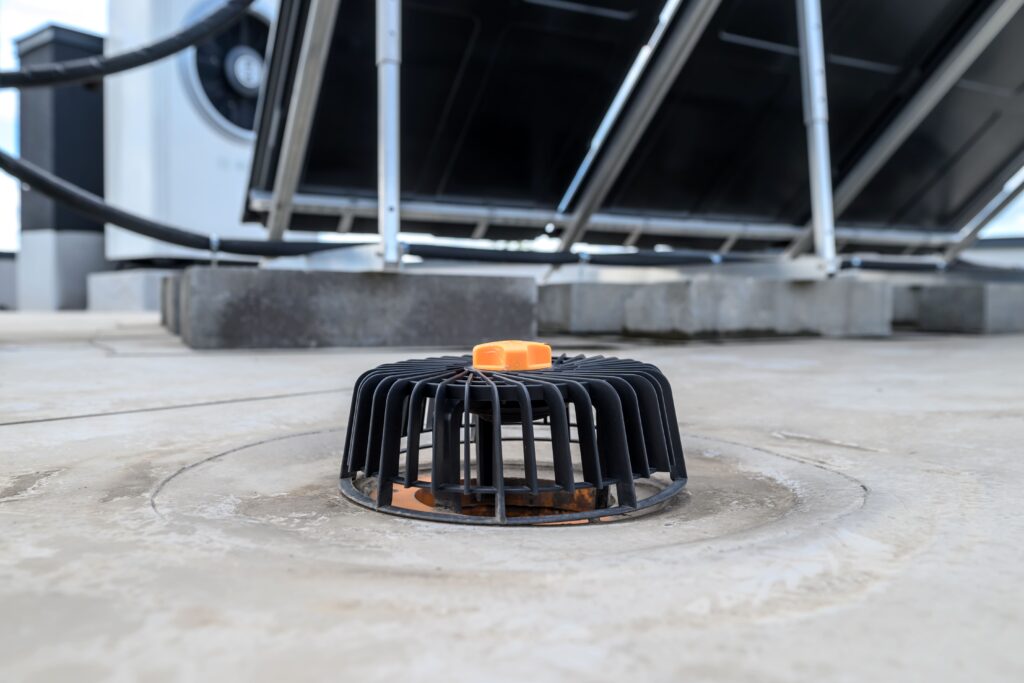
Common on large commercial footprints and modern residential builds with parapet walls, internal drains are placed at the lowest points of the roof. Water enters a drain head and travels through a network of pipes located inside the building to the storm sewer system.
- The Importance of Strainers: Every internal drain must be equipped with a “beehive” or dome strainer. Without these, debris like leaves, twigs, or bird nests can enter the internal plumbing. This causes clogs deep within the building’s walls, which are incredibly difficult and expensive to clear compared to surface-level maintenance.
Scuppers (where they work best)
Scuppers are specialized openings cut into the perimeter walls (parapets) of a roof. They allow water to exit the roof surface and flow into a conductor head and downspout on the building’s exterior.
- Best Use Case: Scuppers are ideal for roofs where internal piping is not feasible or desired. They are highly favored for their ease of inspection; because the water exits the building externally, any blockage is immediately visible from the ground or the roof surface.
Perimeter gutters
Found most often on residential flat roofs or smaller commercial buildings without parapet walls, perimeter gutters are attached directly to the roof’s edge. The entire roof is engineered to slope toward one or two sides, where water flows into traditional open-top gutters and downspouts.
Tapered insulation and crickets for better flow
When the structural deck of a building is level, contractors create a slope using tapered insulation. These are rigid foam boards (usually Polyiso) manufactured with a built-in incline.
- Crickets: These are secondary, diamond-shaped “mini-slopes” installed between drains or behind heavy equipment like HVAC units. They act as diverters, pushing water toward the primary drainage points and eliminating “dead spots” where water naturally tends to pond.
Most Common Drainage Issues on Flat Roofs
Ponding water (what “too long” means)
The National Roofing Contractors Association (NRCA) defines “ponding water” as water that remains on a roof surface 48 hours after a rain event. If you see standing water three days after a storm, your drainage system is inadequate. Ponding accelerates the UV degradation of the roof membrane and increases the risk of “creep” in the building’s structure.
Clogged drains/scuppers (leaves, debris, ice)
Environmental factors are the primary cause of drainage failure. In the fall, foliage is the main culprit. In the winter, ice dams can form inside scuppers or at the mouth of internal drains, creating a frozen plug that prevents snowmelt from escaping, leading to massive weight accumulation.
Improper slope or drain placement
In older buildings, “settling” can shift the low points of a roof. If the building moves, water may migrate to a corner where no drain exists. Similarly, poor initial installation of tapered insulation can result in “birdbaths”—small, shallow pools scattered across the roof surface that never reach the drains.
How to Fix Flat Roof Drainage Problems
Cleaning + installing strainers/screens
The simplest fix is often the most effective. Regularly clearing beehive domes and ensuring scuppers are free of debris can solve a significant portion of drainage issues. If your scuppers clog frequently, installing larger “overflow” scuppers can provide a critical fail-safe.
Correcting slope (tapered insulation)
If ponding is a chronic, widespread issue, the most effective solution is a “re-roof” or “recover” that incorporates a new, mathematically mapped tapered insulation system. This ensures every square inch of the roof has a positive flow toward an exit point.
Adding/relocating drains or scuppers
If a roof has developed a permanent low spot due to settling, professionals can “tap” into existing internal plumbing to add a new drain at the current low point. For roofs with parapets, cutting an additional “overflow scupper” two inches above the primary drain is a code requirement in many U.S. jurisdictions to prevent total flooding if the main drain fails.
FAQs
Why does my flat roof hold water after rain?
This is usually caused by inadequate slope or a “dead spot” created by the building’s structural shifting. It can also be caused by the weight of heavy rooftop equipment pulling down the roof deck over time.
Are scuppers better than internal drains?
Scuppers are generally more cost-effective to maintain and carry a lower risk of causing interior water damage if they leak. However, internal drains are superior for very large roof areas where water would have to travel too far to reach the perimeter.
How often should flat roof drains be inspected?
At a minimum, you should inspect your flat roof drainage twice a year—once in the Spring and once in the Fall. It is also highly recommended to perform a visual check after any major weather event involving high winds or heavy snowfall.
Don’t let standing water compromise your investment. Contact us today for a comprehensive roof drainage audit and protect your building from the hidden costs of ponding water.