
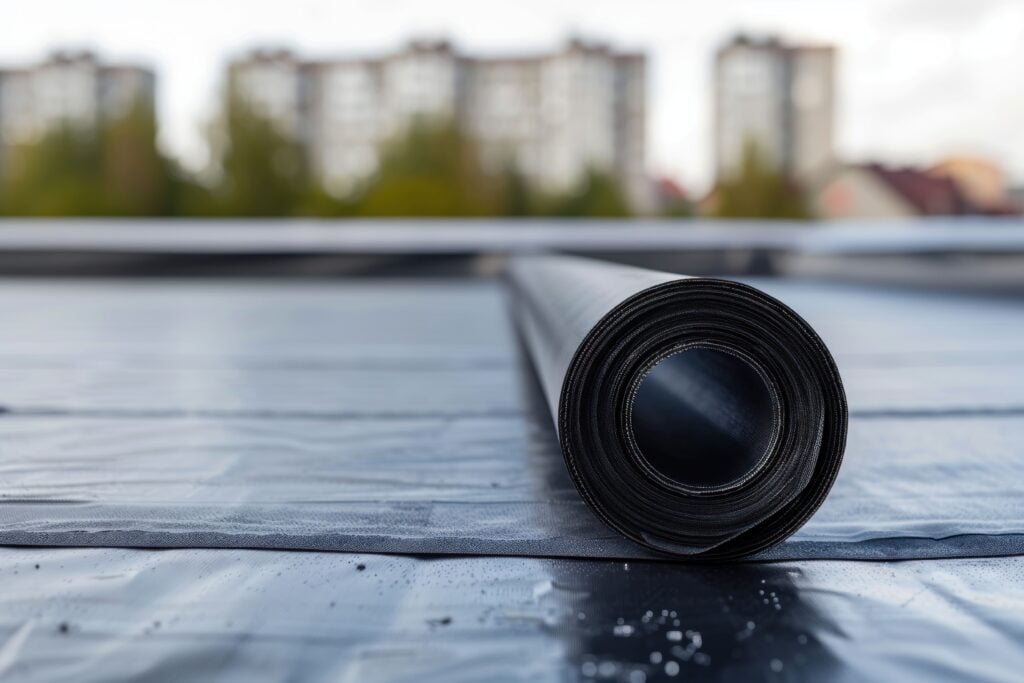
Choosing the right membrane for a commercial property is a high-stakes decision. In the United States, the choice often comes down to balancing upfront installation costs against long-term energy savings and the specific environmental stressors of the building’s location.
Quick Answer: EPDM, TPO, PVC, and Modified Bitumen Are Most Common
Modern commercial roofing is dominated by Single-Ply Membranes (EPDM, TPO, PVC) and Multi-Ply Systems (Modified Bitumen). While EPDM is the traditional “workhorse” of the industry, TPO and PVC have gained massive market share due to their heat-welded seams and superior energy reflectivity.
EPDM Rubber Roofing (Ethylene Propylene Diene Monomer)
EPDM is a synthetic rubber membrane that has been a staple of the US commercial market for over 40 years. It is typically black, though white reinforced versions are available.
Lifespan
A properly installed and maintained EPDM roof can last 25 to 30 years. Its carbon black base makes it incredibly resistant to UV radiation and thermal shock.
Pros and Cons
- Pros: Very cost-effective; remains flexible in extreme cold; high resistance to hail and ozone.
- Cons: Black surface absorbs heat (increasing cooling costs); adhesive-based seams are more prone to failure than welded seams; susceptible to damage from oils and greases (not ideal for restaurants).
TPO Roofing (Thermoplastic Polyolefin)
TPO is the fastest-growing segment of the US commercial roofing market. It is a single-ply reflective membrane composed of polyprophlene and ethylene-propylene rubber.
Energy Efficiency
TPO is inherently “cool.” Its white or light-grey surface reflects the sun’s rays, significantly reducing “Heat Island Effect” and lowering HVAC costs during hot American summers. Most TPO products are Energy Star rated.
Durability
TPO offers the benefit of heat-welded seams, which are physically stronger than the membrane itself. It is highly resistant to punctures, tears, and bacterial growth. However, because it is a newer technology, the formulation of TPO can vary between manufacturers, making brand choice critical.
PVC Roofing (Polyvinyl Chloride)
PVC is the “premium” choice for single-ply roofing. It is highly flexible and includes plasticizers that allow it to withstand significant structural movement.
- Best For: Restaurants and chemical plants. PVC is uniquely resistant to animal fats, grease, and many industrial chemicals that would dissolve EPDM or TPO.
- Lifespan: 20 to 30 years. Like TPO, its seams are heat-welded for a permanent, watertight bond.
Modified Bitumen (Mod-Bit)
Modified Bitumen is an evolution of traditional “built-up” roofing. It consists of multiple layers of asphalt-saturated fabrics.
- Application: Often installed in two or three layers (base, ply, and cap sheet).
- Durability: Exceptional. Because it is a multi-layer system, it is the most resistant to heavy foot traffic and mechanical damage.
- Lifespan: 20 years. It is less energy-efficient than TPO/PVC unless a specialized reflective coating is applied.
Which Material Is Best for Massachusetts Weather?
In Massachusetts, roofing systems must survive the “Big Three”: heavy snow loads, hurricane-force coastal winds, and the freeze-thaw cycle.
- EPDM is a top contender for MA because its black surface helps melt snow faster in the winter, and its flexibility prevents cracking during the state’s rapid temperature swings.
- PVC is excellent for coastal MA properties because it handles high wind uplift and salt spray exceptionally well.
- TPO is the preferred choice for newer “Green” buildings in the Boston area looking to meet strict energy codes.
FAQs
What is the most durable flat roof material?
PVC and Modified Bitumen are generally considered the most durable. PVC offers the best chemical and fire resistance, while Modified Bitumen offers the best physical “toughness” against foot traffic.
Which is most cost-effective?
EPDM usually has the lowest installation cost per square foot. However, if energy savings are factored in, TPO often provides a better long-term ROI in sunny or high-utility-cost regions.
Which is best for snow load?
EPDM is the traditional favorite for heavy snow regions. Its dark color absorbs solar heat to assist with snowmelt, and its elasticity allows it to stretch under the weight of a heavy snowpack without tearing.
Get a Commercial Roofing Quote
Selecting the right material requires an on-site evaluation of your building’s structure, insulation, and usage.
Contact our Massachusetts-based team today for a professional consultation and a detailed quote tailored to your facility’s specific needs.